Round Hill
The Colour Out of SpaceRound Hill is a secluded Vermont hill where inherited stories of hidden beings, Henry Wentworth Akeley’s discovery of a mysterious black stone, and an alleged alien outpost converge. Its decisive significance is the change it marks in the story: a place long avoided through fading custom becomes the setting for evidence that the old warnings may have described something real.
Setting and Folklore
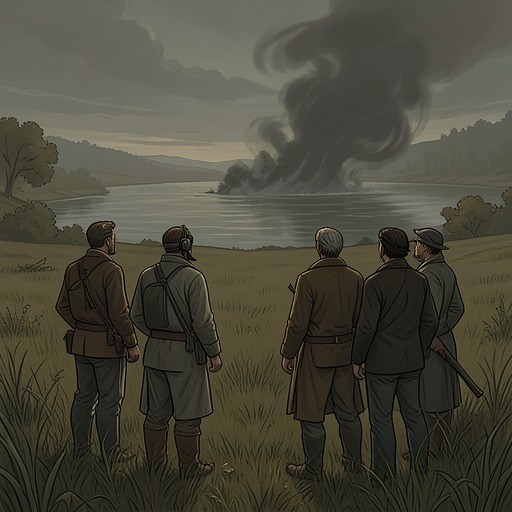
The hill belongs to a wider landscape of remote Vermont heights, deep valleys, and settlements shaped by old fears. In the folklore Albert N. Wilmarth had studied, uncanny beings were said to inhabit secluded hills and gorges; reports of unusual tracks, stone circles, blocked caves, and rare sightings accumulated around such places. Stories also described disappearances and a customary reluctance to build or travel in certain districts. Round Hill was later named alongside Dark Mountain as a notoriously haunted spot, though no one Albert N. Wilmarth questioned had closely explored either.
The traditions did not survive as a continuous, openly acknowledged system of belief. As routes and dwellings settled into familiar patterns, people retained the reputation of some hilly areas as unhealthy, unlucky, or unprofitable while forgetting the fears that had helped shape those patterns. The hills were left deserted more through custom and economic habit than through a conscious decision to avoid their inhabitants. This history gives Round Hill an unsettling double character: it appears neglected by accident, yet local avoidance has preserved the very isolation that makes it a plausible refuge.
The Black Stone and Akeley’s Investigation
Henry Wentworth Akeley reported finding a large black stone in the woods on Round Hill, east of his home. Its hieroglyphics were worn almost away, and photographs showed little. In his account to Albert N. Wilmarth, the discovery marked a turning point: after he brought the stone home, he felt that circumstances had changed and suspected that the beings he was investigating meant to silence him or remove him from Earth. He believed they sometimes took learned people to keep informed about human affairs.
Akeley’s concern was not simply that the hill held an unexplained object. He argued that the beings maintained mines beneath the hills and warned that human curiosity could provoke danger. He also urged Albert N. Wilmarth to discourage public attention and keep people away from the hills, particularly as development threatened to bring summer visitors and construction into wild areas. The stone thus connects local history, the prospect of concealed activity underground, and Akeley’s effort to keep the place out of public view.
The Alleged Outpost
During Albert N. Wilmarth’s visit to the Akeley farmhouse, an explanatory voice identified Round Hill as the location of a principal outpost. The account described a cosmopolitan collection of cylinders and instruments there, including devices associated with beings whose senses differed from human ones. It also referred to the outpost’s extra-cosmic brains, allies, and explorers, and to machines intended to let different kinds of beings receive impressions and communicate through forms suited to them.
This account gives the hill a role beyond that of a folkloric hiding place: it becomes a station in a network of beings extending far beyond Earth. The same scene makes the claim concrete through the apparatus at the farmhouse. More than a dozen unfamiliar metal cylinders stood on a shelf, and one was connected to testing machines. The explanation links such equipment to the cylinders and instruments said to be found at the Round Hill outpost, while leaving the outpost itself unseen.
Reputation and Narrative Significance
After escaping, Albert N. Wilmarth made inquiries in Brattleboro. People told him that suspicious sights and sounds around Henry Wentworth Akeley’s house had increased after the stone’s discovery, and that the house was now avoided by almost everyone. Round Hill and Dark Mountain, he learned, had long been regarded as haunted and remained largely unexplored. Local reports also included disappearances over the district’s history, among them that of Walter Brown, whom Akeley’s letters had identified as a suspected spy. These reports strengthen the connection between the hill’s reputation and Akeley’s fears without turning every local story into independently verified fact.
A fragment of a later conversation mentions that Noyes can watch Round Hill and refers to a fresh cylinder and Noyes’s car. The fragment suggests continued attention to the site and its equipment, but does not establish what was ultimately done there. Round Hill’s narrative force lies in that mixture of accumulated reputation and incomplete disclosure: old avoidance customs first appear to be superstition, then become a framework for interpreting the black stone, the alleged outpost, and the watchers associated with it.